
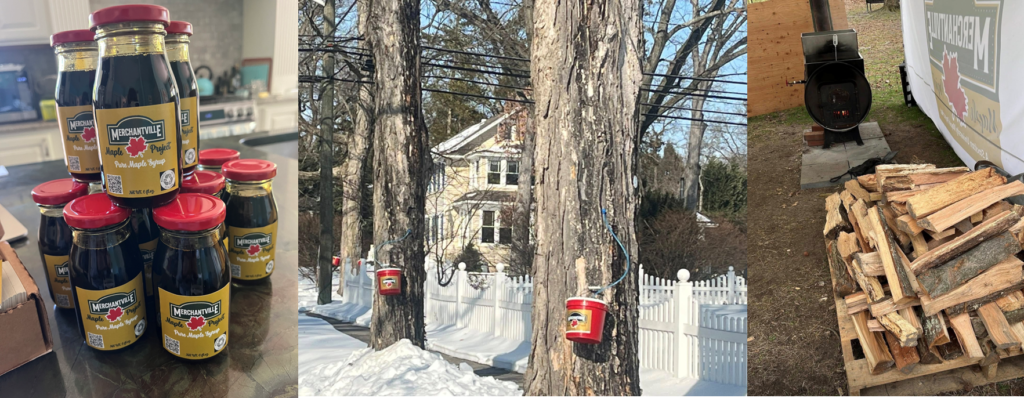
This month, Sustainable South Jersey board members visited Incredible Edible Merchantville, one of our 2024 mini grant recipients, and spoke with Joan Brennan to learn more about how their maple sugaring program has progressed at the Merchantville Community Center.
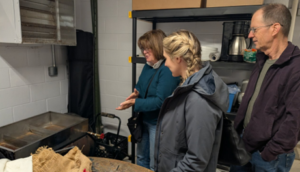
“Maple sugaring is completely dependent on the weather-you need freezing nights and warmer days. When that freeze-thaw cycle occurs, tree pressure expands and sap flows.” – Joan Brennan
That reality shaped this year’s entire season.
After hosting their workshop in late January, the team expected to begin collecting sap shortly after, with sap flow depending on a delicate balance: freezing temperatures at night and warmer temperatures during the day. Instead, an extended cold stretch delayed everything. Trees remained frozen, and so the season didn’t truly begin until mid-February. From there, the window was short- just a few weeks between the first boil on February 18 and the final boil on March 11.
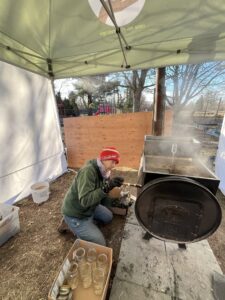
And yet, in that compressed timeframe, the community showed up. Volunteers, organized and coached by Kathy Manetas and Dorothy Foley, collected over 440 gallons of sap from maple trees across town. By the end of the season, approximately 457 gallons had been boiled down over 173 volunteer hours, resulting in 13.25 gallons of finished syrup.
It’s a process that demands patience. On average, it takes more than 30 gallons of sap to produce just one gallon of syrup. Last year, the team saw a ratio closer to 45:1. This year, through a series of small but meaningful improvements, including better heat retention, adjustments to the evaporator, and the addition of a wind-blocking tent, they brought that ratio down to 34.5:1. Over 17 boil days, community members rotated through shifts of tending fires, monitoring temperatures, and making sure the sap didn’t spoil or overcook.
Throughout the season, local students and community groups visited the site, including the Merchantville Elementary School Junior Green Team and Urban Promise youth. For many, it was their first time seeing how something as simple as tree sap becomes a finished product. Tasting it, watching it boil, and understanding the conditions required creates a connection that’s hard to replicate in a classroom.
What makes this project particularly compelling is how local it is. The trees are along neighborhood streets. The work is done in a shared community space. The final product is sold at local events, like Merchantville’s First Friday Farmer’s Market. It’s a close loop that keeps both the environmental and community benefits close to home.
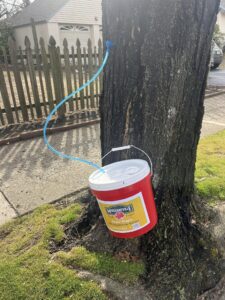
And it raises an interesting possibility: could other towns do the same?
Merchantville’s success is tied to a few key factors – a strong tree inventory, manageable geography, and a committed group of volunteers. But the broader model is adaptable. With the right conditions and coordination, this type of hyper-local, community-led sustainability effort could take root elsewhere in South Jersey.
This kind of experiential learning closely reflects SSJ’s mission to inspire personal connections to South Jersey’s ecological resources. Their work shows how local, community-led initiatives can evolve and scale over time.
We’re proud to have supported this project through our mini grant program and look forward to seeing it continue to grow.